

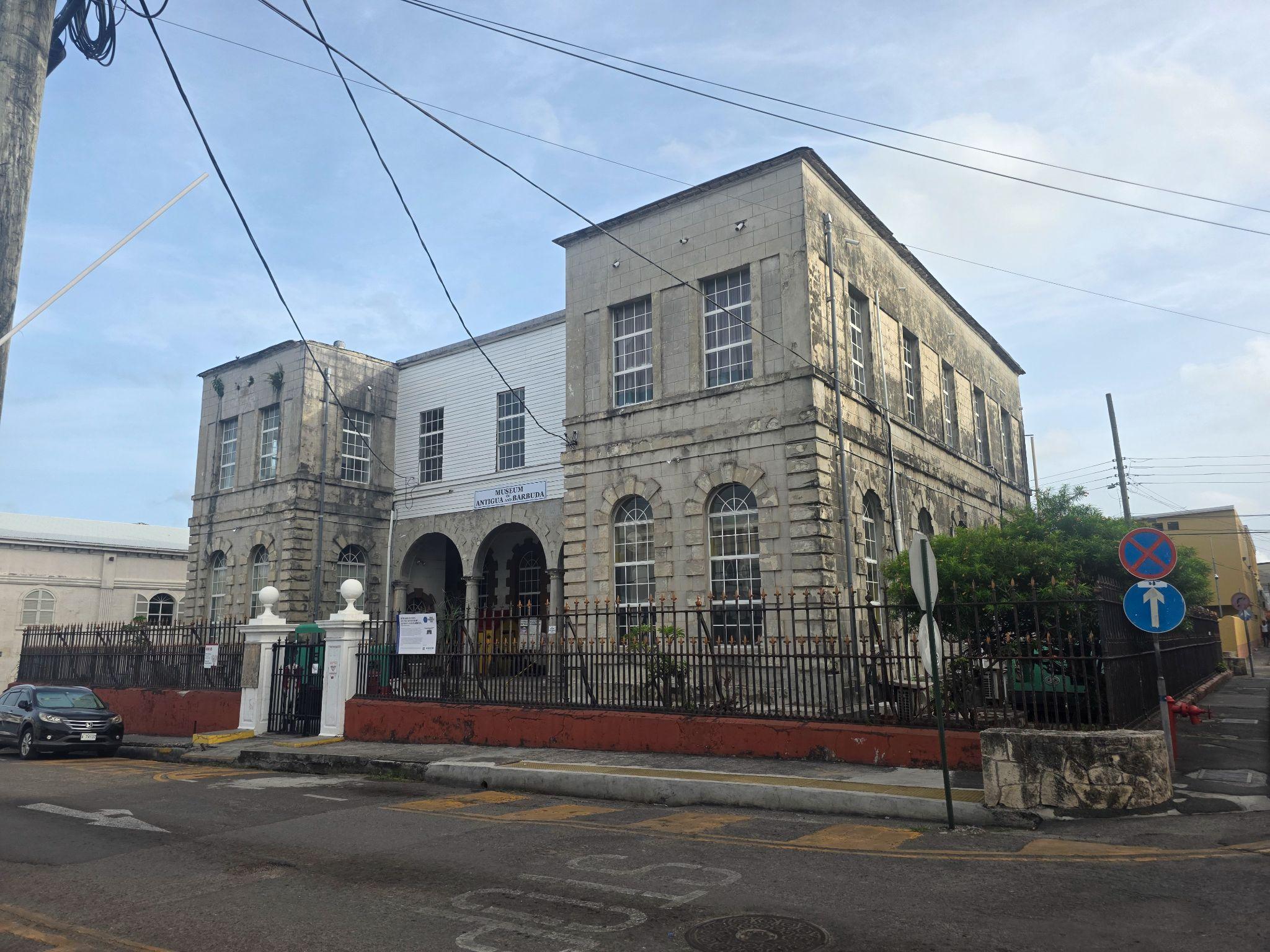
The Old Court House / Museum
The Museum is housed in the old Court House, constructed in 1747 and the oldest building still in use in the city. The building was seriously damaged in the 1843 earthquake and the support of the upper floor was strengthened with the addition of large Victorian cast iron pillars, still visible in the hall today.
With a fine tuscan door surround and generous arched openings across the ground floor, it stands as a fine example of a Georgian classical building.
The Building
Unlike the Barclays Bank building, the Museum facade has changed over the years.
The design for the building is attributed to Peter Harrison but it seems likely that it was executed by the mason builder, William Lowry, and the carpenter, Duncan Grant. The building was completed in 1750, with construction paid for with taxes and loans from the estates of Jonas Langford and Samuel and Thomas Watkins. The style was Georgian.
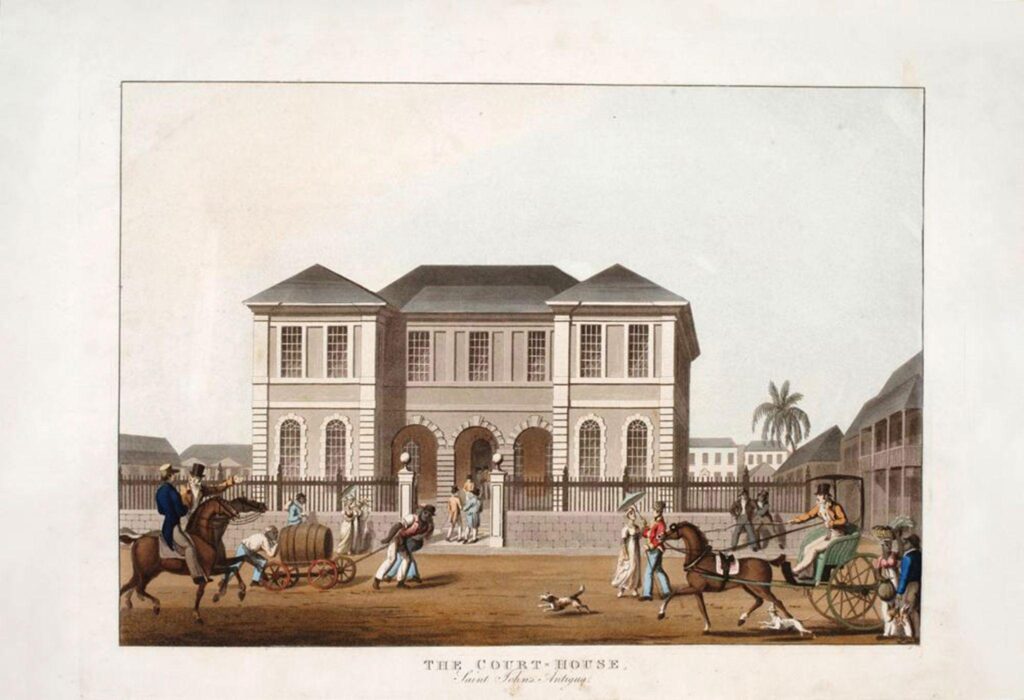
John Luffman, a visitor to the West Indies in 1786, wrote this description of the building: “The Court-house, situated nearly in the center of the town, is built of stone brought from Pelican Island, about nine miles distant, which is a good material similar to that of Portland. This building is esteemed the best in the British West-Indies; here the Courts of Justice are held, the Council and Assembly meet, and the public dinners and balls are kept.”
This aquatint, from 1823, shows the building when it had a hipped roof.
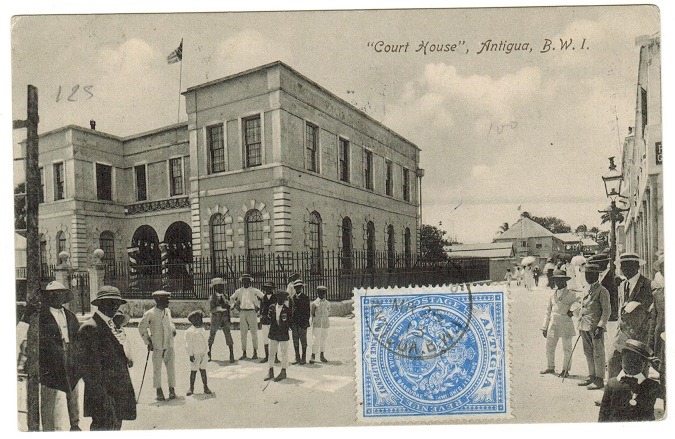
By the early 1900s, the hipped roof was hidden by a new parapet. This photo is from 1913.
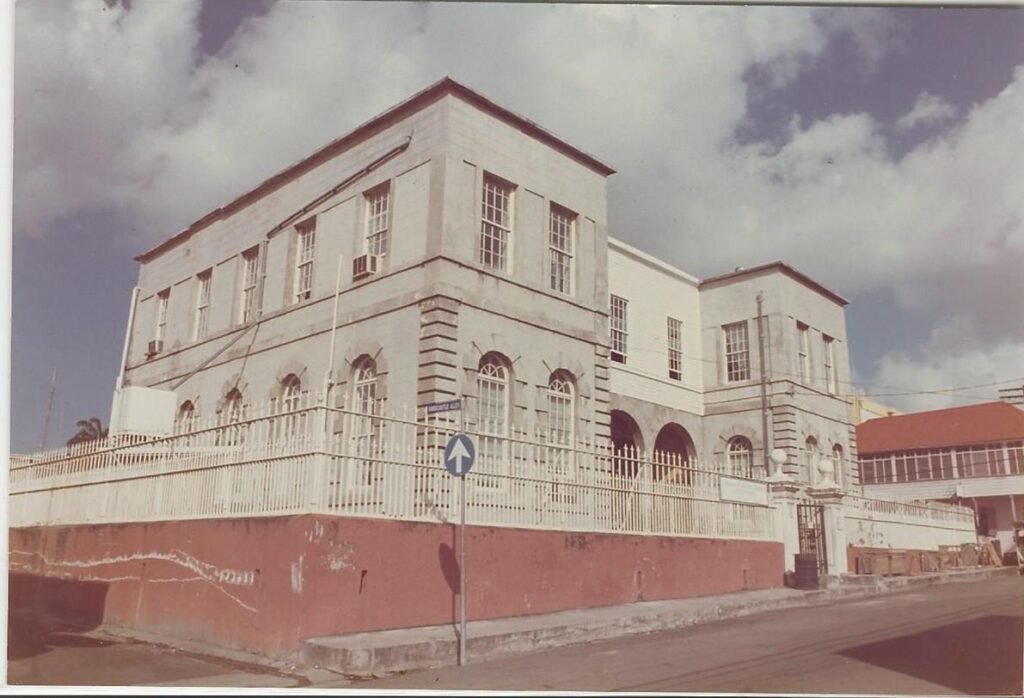
The Court House suffered damage in the 1974 earthquake, which damaged many buildings in St. John’s, including the Cathedral. It was declared unsafe but was then renovated by the British Government with funds for overseas aid. It briefly housed the National Archives but since 1985 has housed the Museum of Antigua and Barbuda, under the auspices of the Historical and Archaeological Society (HAS). In addition to a library in the mezzanine, numerous public events have been held in the upstairs auditorium and in the Museum itself.
This photo shows the Museum in 1993.
Uses of the Building
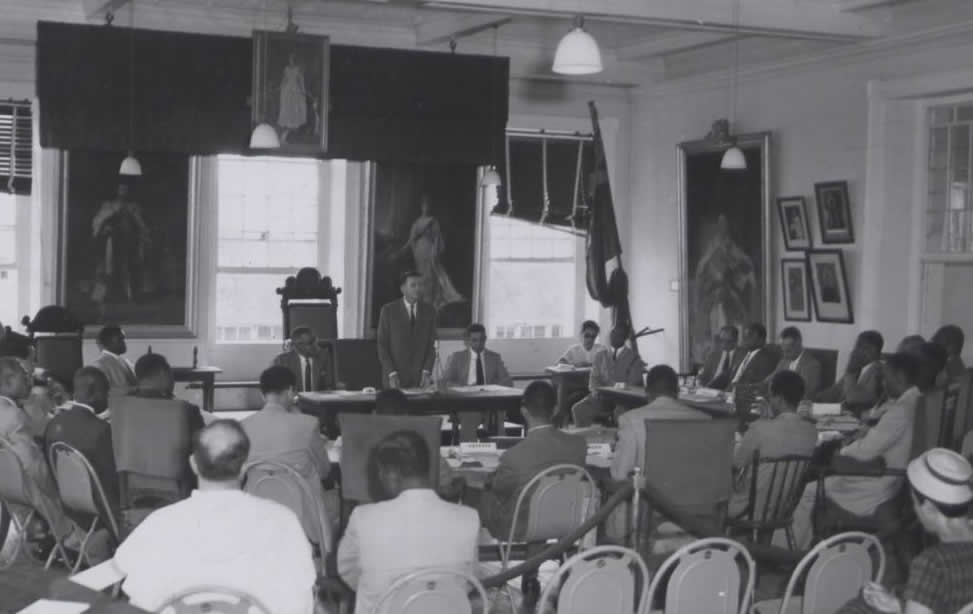
The building has had many uses over the years. Until the 1974 earthquake, the Court of Justice was held on the ground floor while the upstairs was used as meeting rooms for the Legislative Council and Assembly. The photo shows a meeting of the Legislative Council in 1961.
From the beginning, the building was also used for lectures, charity balls, bazaars, official dinners and teas. In 1786, John Luffman described a dinner, followed by a ball: “I dined at the Court-house, on the 4th instant, with the Governor, Council, and Assembly; the dinner and wines good, the company convivial. In the evening was a ball. The creole ladies are lively dancers, and the heat of the clime does not in the least prevent them from engaging even to an extreme in this their favourite amusement. It was two o'clock before I got home, well satisfied with having spent several hours both cheerfully and agreeably.”
As Mrs. Lanaghan said in Antigua and the Antiguans, written in 1843, the building has “seen many a smiling face and echoed the sighs of many a heart.” These events usually took place on the upper floor, where the Legislative Council met. Tables were removed while the area which housed the Assembly was used for serving food.
Under the leadership of HAS, the Museum has continued to host public and private events, including lectures, exhibitions, concerts, and book launches. HAS also produces a quarterly monthly newsletter that contains short articles on many aspects of Antigua’s history.