

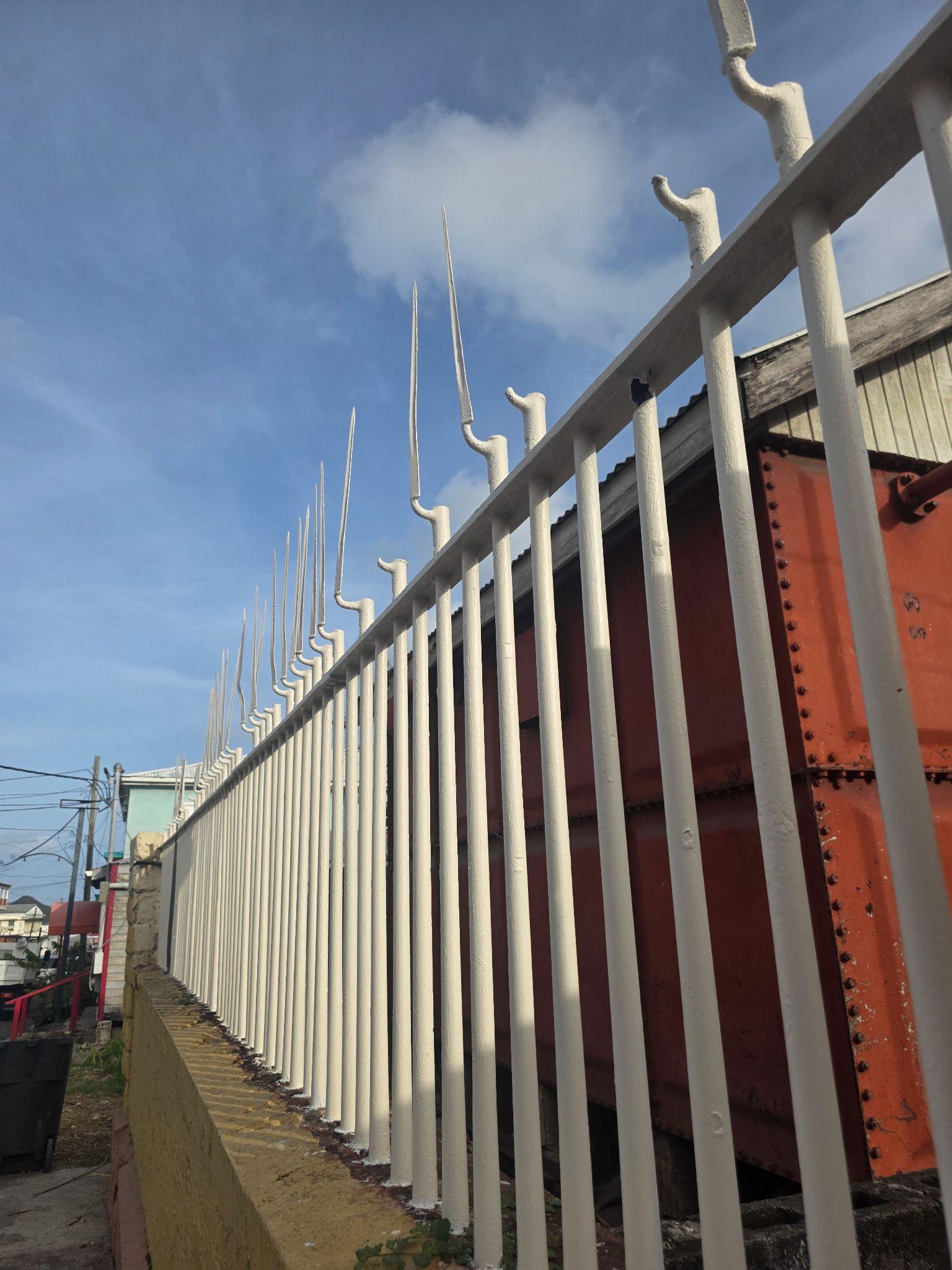
Bayonet Fence
Across Church Street from the Museum, the Police Station yard has a unique iron railing, composed of Long Land Pattern Brown Bess muskets and bayonets, weapons used by the Antigua militia during slavery. These were placed there after the militia surrendered its weapons in 1838, four years after Emancipation in 1834. The fence is believed to be the world’s only surviving example of an intact musket and bayonet fence.
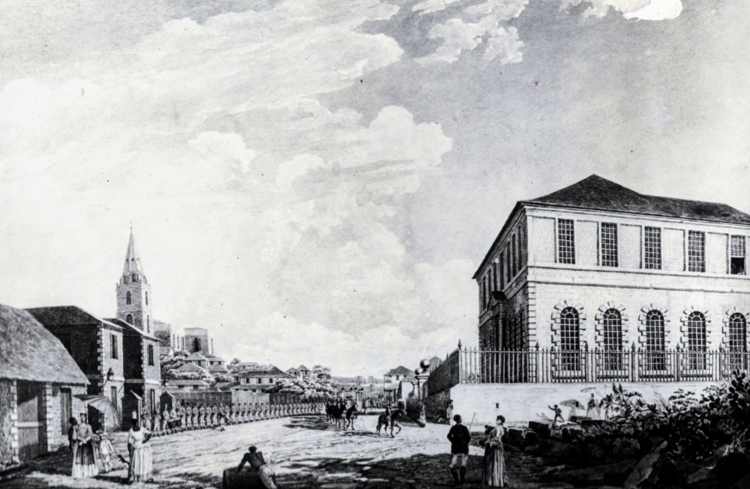
This water-colour drawing by Thomas Hearne, dated approximately 1772, shows the back of the Courthouse on the right, the Police Station yard on the left, and a military parade along the fence, before the bayonets were in place.
Four years after emancipation, on July 1, 1838, the Antigua Militia was disbanded as a cost-saving measure. Unlike the other Caribbean colonies, the Assembly in Antigua opted for immediate and full emancipation on August 1, 1834, with no apprenticeship period. The traditional colonial militias, which primarily existed to enforce enslavement, guard against slave rebellions and defend British territory, became obsolete overnight. Some of the collected muskets of the Militiamen were formed into a fence, where they remain with their muskets pointing to the skies. The “Brown Bess” muskets found on the fence are Long Land Pattern Muskets (c.1760-1780) with 42-inch barrels. At least two barrels bear regimental marks. The clearest has “2nd XV Regt.” Proofmarks are also visible, for example: “GR in the reign of Geo III.” Many bear Roman numerals that are arsenal assembly marks. In addition, the Ordinance inspector’s number “5” and the crown indicate that they were originally destined for the British Army. Many of the muskets and bayonets were ex-military, and although there is variation in their dimensions, they will have been made by different manufacturers and so this is to be expected.